Your BD week is a receipt for tools that don't talk.
A typical 8-person federal shop runs a legacy platform for intel, a spreadsheet for pipeline, SharePoint for capture, Word for win themes, and a CRM nobody updates. The work lives in the gaps between them.
The question that should take 10 seconds, “what's our position on this pursuit,” takes a 30-minute meeting.
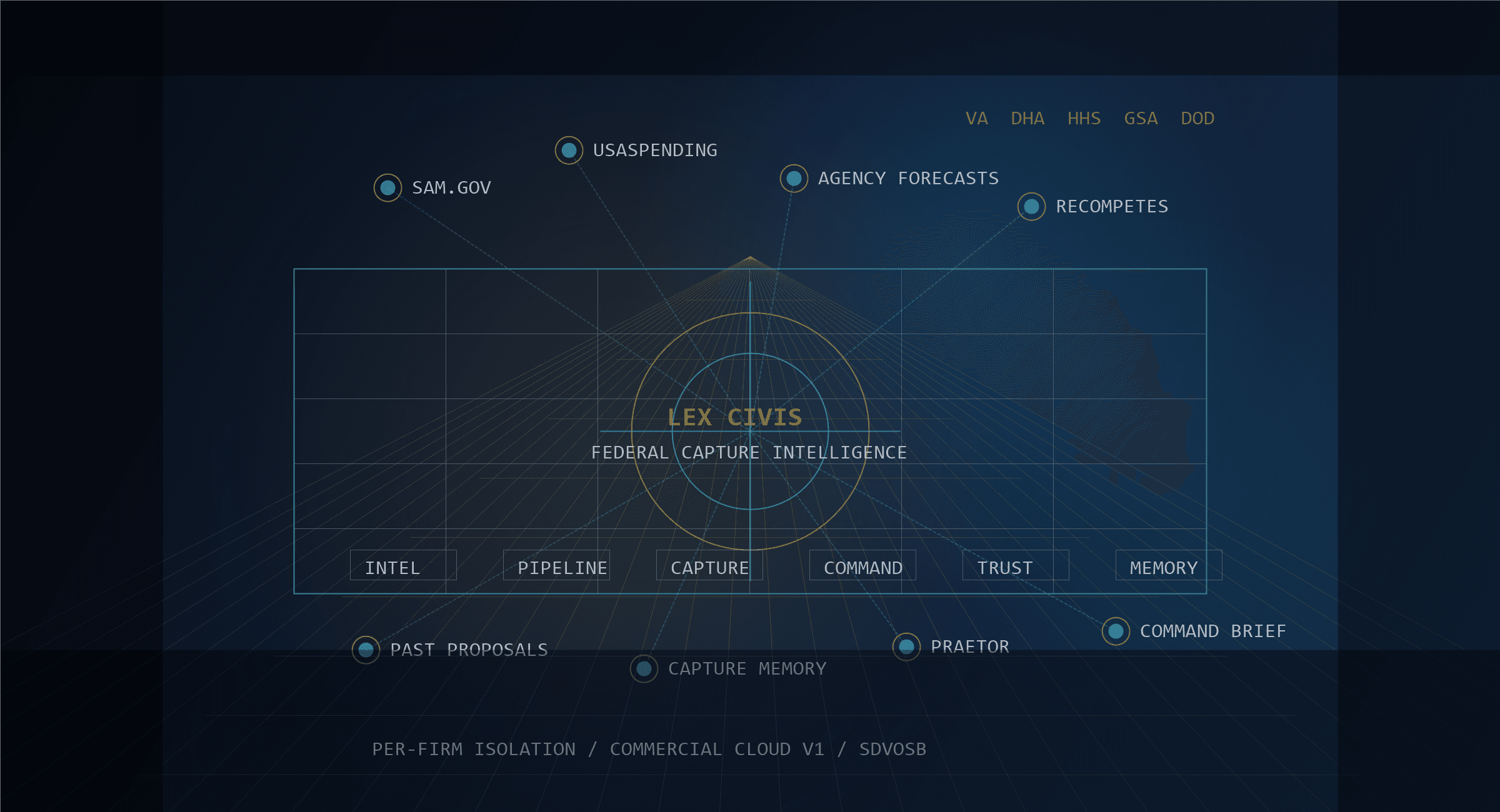
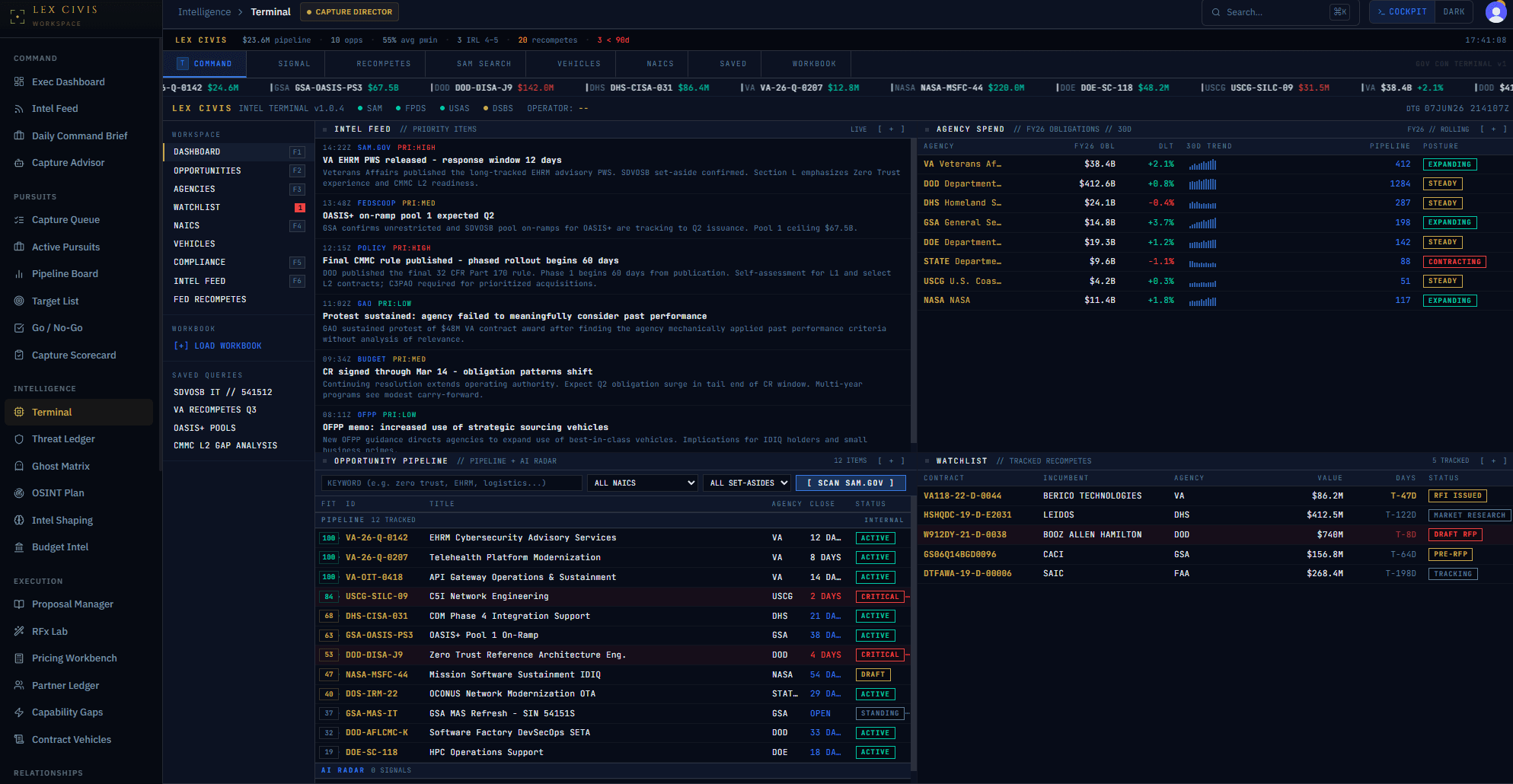
Four surfaces. One shared brain.
Intel, Pipeline, Capture, and Command, in one workspace, with five agents doing the connective work between them.
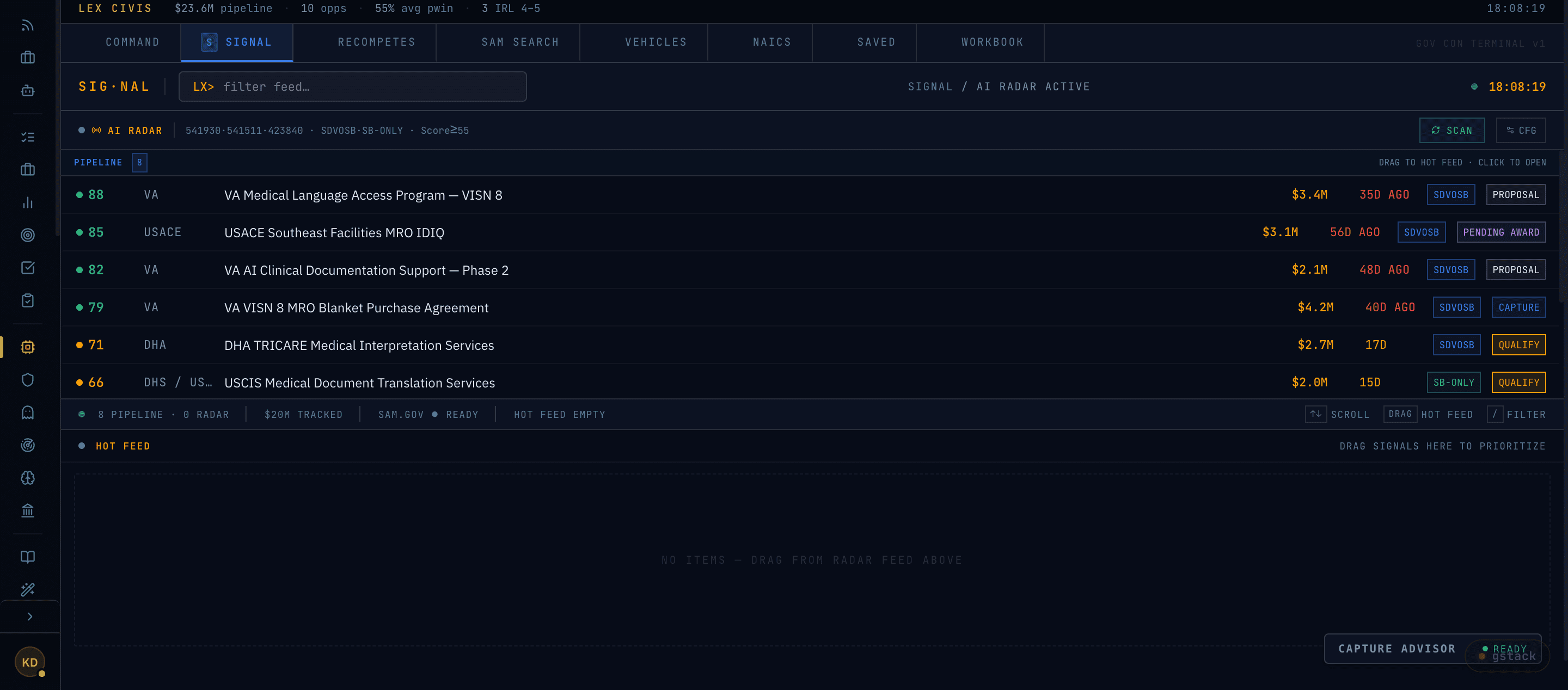
You stop missing opportunities. Every signal that matters hits one feed.
AI Radar scores every SAM.gov signal to your fit profile.
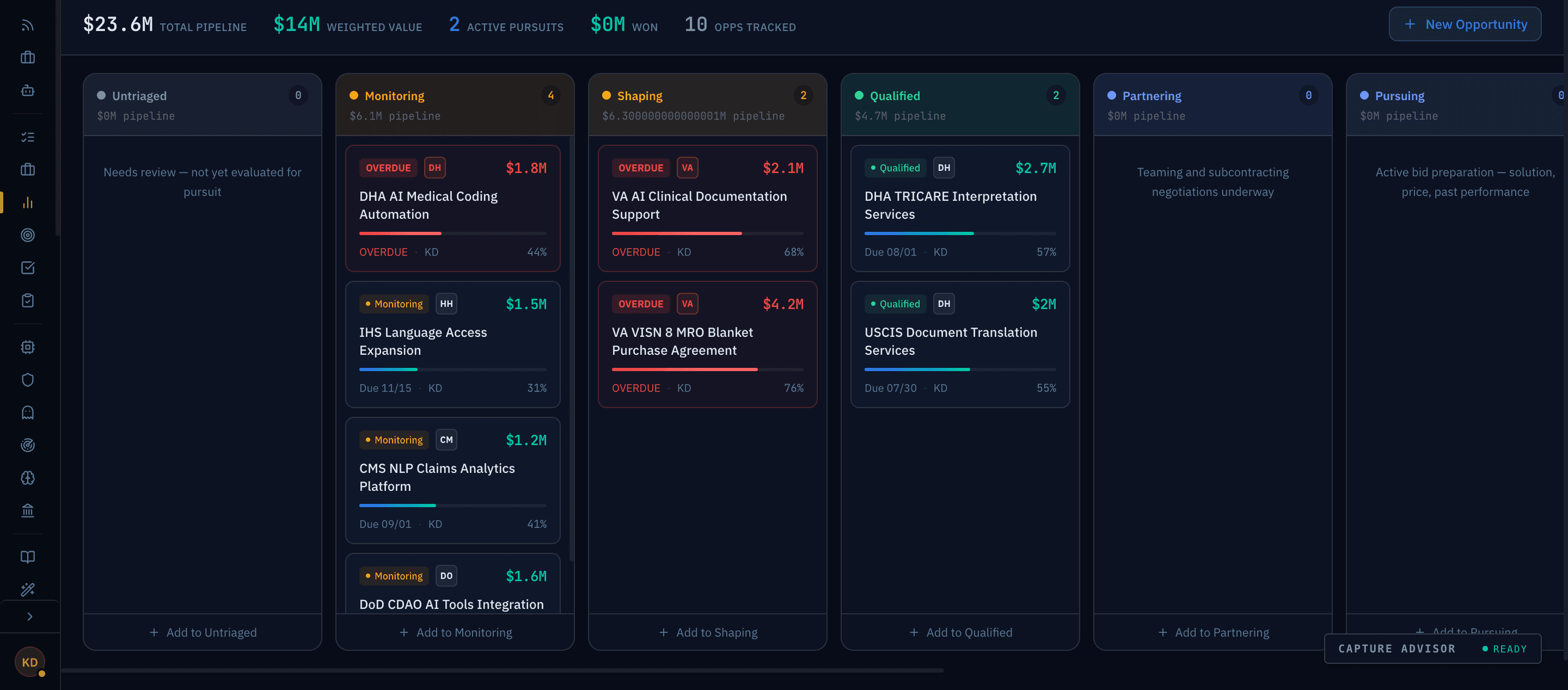
Your pipeline is the source of truth, not the file someone forgot to update.
Kanban pursuit lifecycle · PWIN scored per card
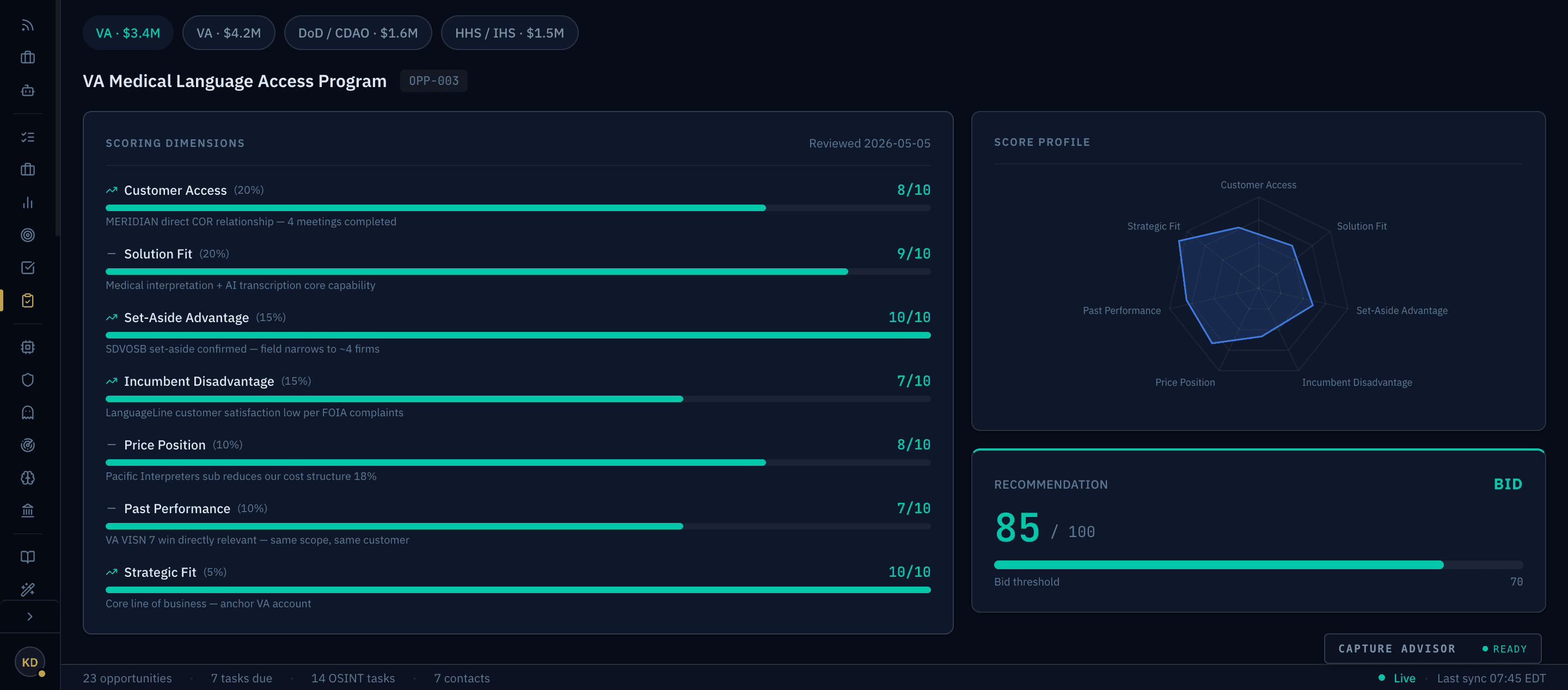
Every pursuit walks into review with a capture read and win-theme starters.
Weighted BID score, 85/100, with rationale
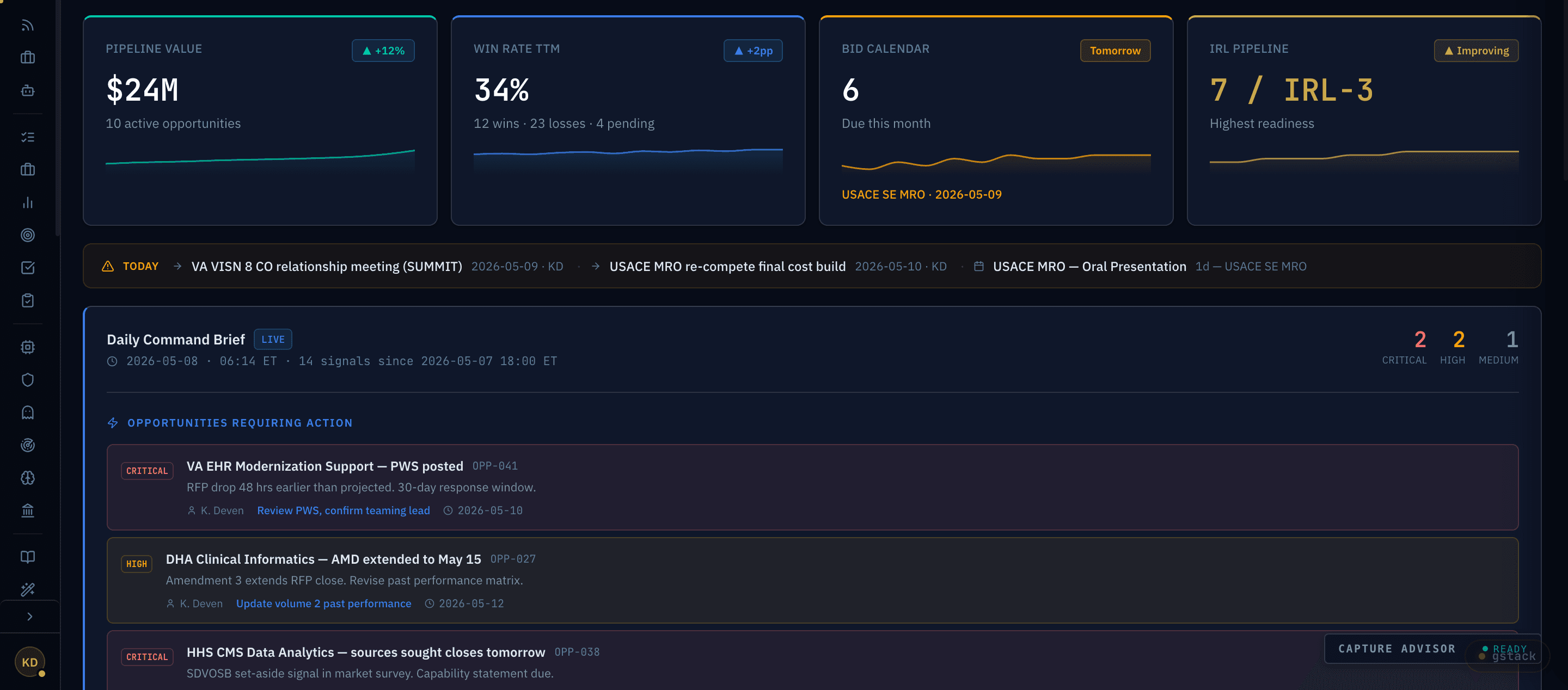
Your principal opens one tab in the morning and knows exactly where every pursuit stands.
Pipeline value · win rate · Daily Command Brief
Not just the director's tool.
The workspace re-contexts to each seat. The director sees the $24M portfolio. The analyst sees OSINT targets and the intel request queue.
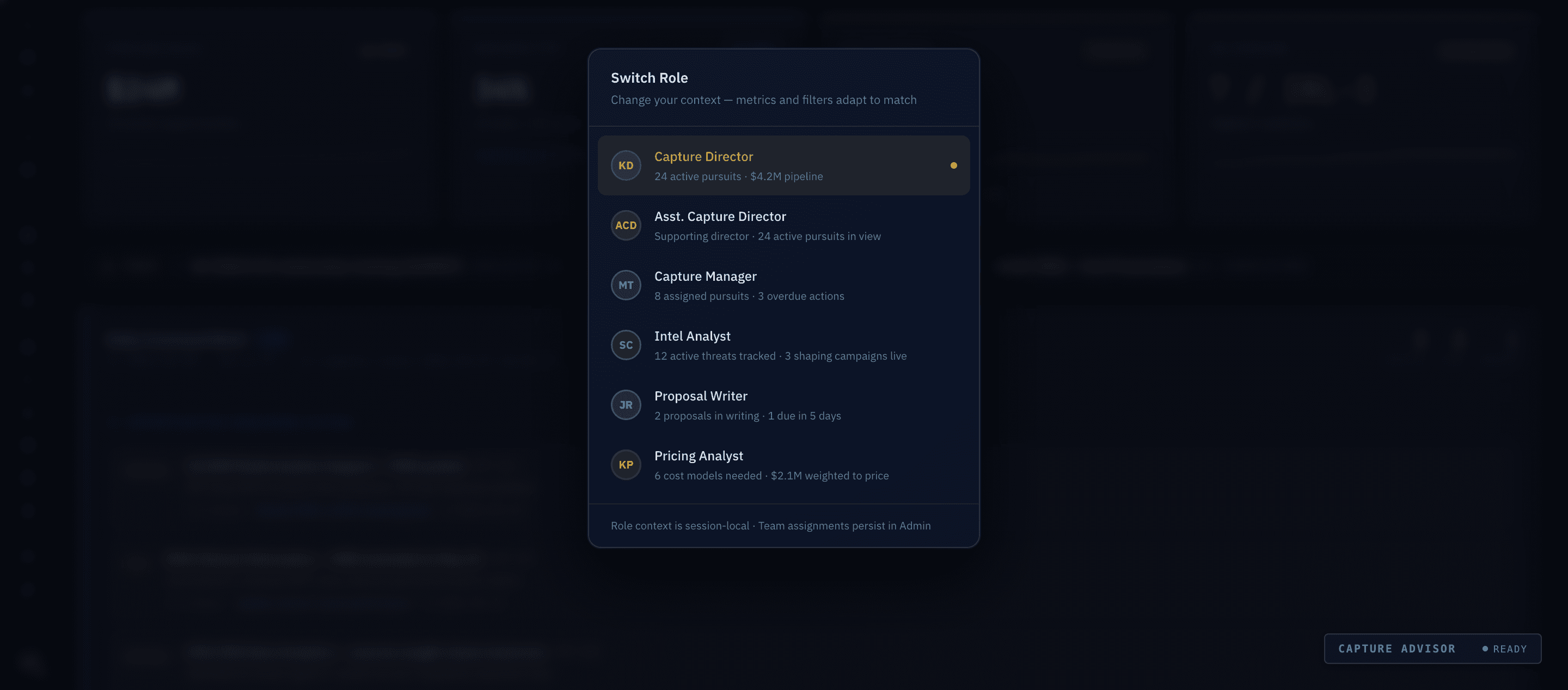
Switch role — metrics adapt
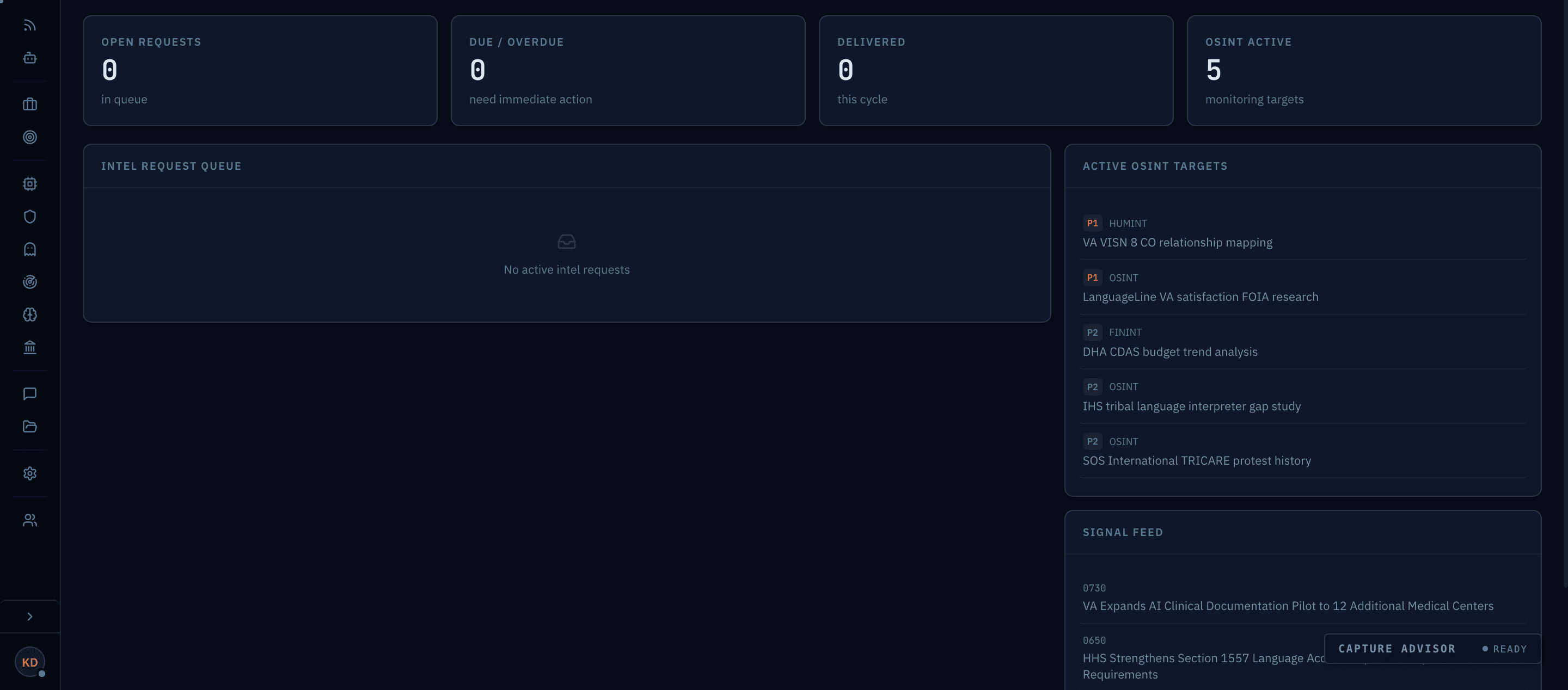
The same workspace, as the Intel Analyst
One workspace replaces a stack the primes use against you.
A typical 8-person federal shop runs four tools and 60+ manual hours a month to do what one workspace can do in the background.
| MANUAL / SPREADSHEETS | LEGACY PLATFORMS | LEX CIVIS | |
|---|---|---|---|
| Setup time | Weeks | 4–8 weeks of implementation | 24 hours |
| Cost, per firm | 60+ hrs/month of labor | $25K–$40K/yr in seats & licenses | From $600/mo |
| Contract length | — | 1–3 year lock-ins | Month-to-month |
| SAM.gov coverage | Manual searches | ✓ | ✓ |
| Opportunity scoring | Gut feel | Generic templates | AI-scored to your fit profile |
| Capture plan drafting | Word doc from scratch | Empty SharePoint folder | Capture read + win-theme starters |
| Win-theme generation | ✕ | ✕ | 3 starters per pursuit |
| Incumbent threat tracking | Manual research | Partial (legacy) | Threat Ledger, continuous |
| Daily executive brief | ✕ | ✕ | Command Brief, configured during onboarding |
| Built for SDVOSBs / firms <50 | — | Built for primes | Purpose-built |
| Seats | — | Per-seat pricing | Per-firm, seats by tier |
Legacy GovCon platforms weren't built for your firm. They were built for the primes you compete against. Lex Civis is built for the 8-person team that wears 24 hats.
Your firm forgets what it promised. The workspace doesn't.
Every proposal you've submitted, every RFP you've answered, every go/no-go memo you've written holds the answer to the next pursuit. Today that knowledge lives in one person's head and a SharePoint folder nobody opens.
Drop those documents in. The workspace reads them, indexes them, and keeps them where only your firm can reach them. When the next solicitation lands, the capture plan already knows what you said last time.
Tuesday, 2:14pm. You're in a meeting. The workspace is working.
An amendment drops on a recompete you chased two years ago. It posts to SAM.gov at 2:14. By the time you're back at your desk, Intel has scored it against your own pursuit history, Capture has surfaced go, caution, or pass signals, and your Section L outline is already started. You didn't miss it. You just weren't the one watching.
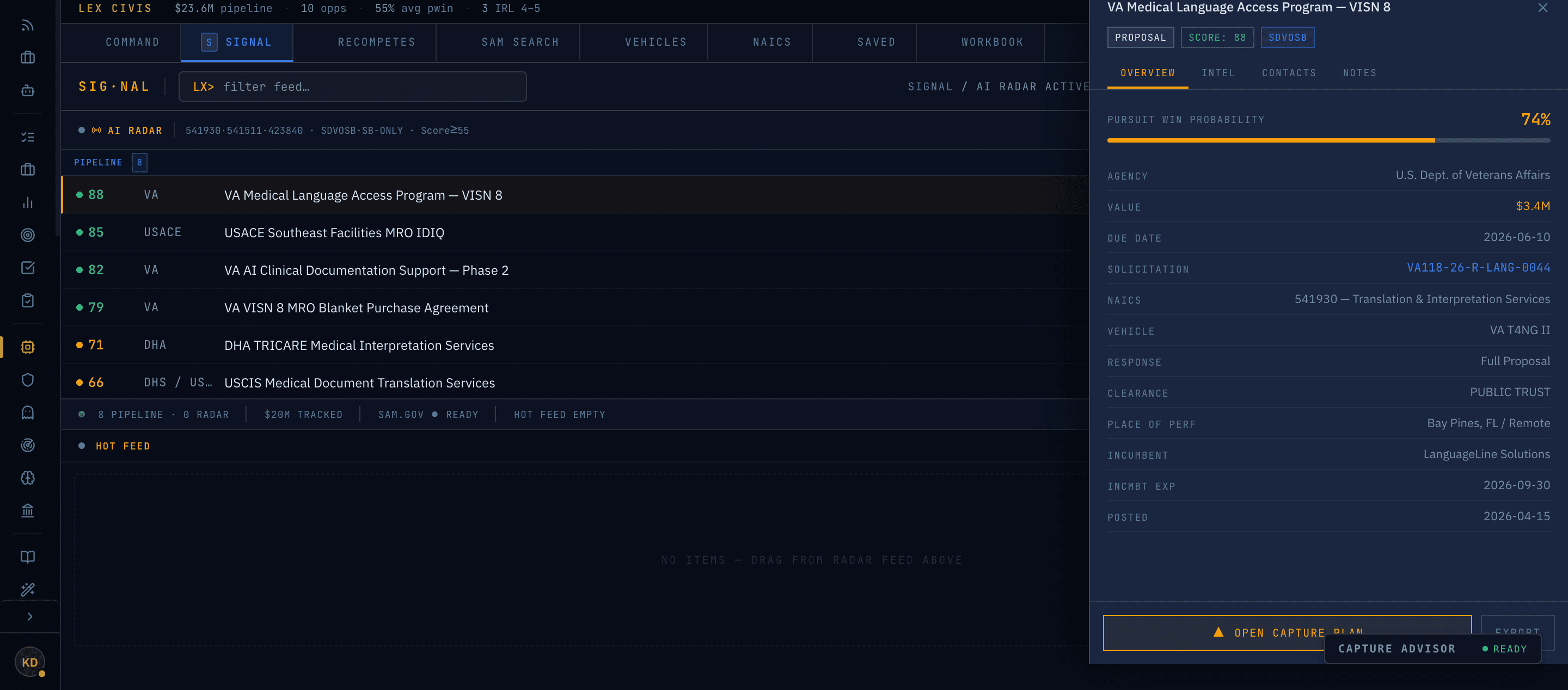
One click on a signal → the full capture read: PWIN, incumbent, solicitation.
While you sleep, five agents work your pipeline.
The connective work between every BD surface — handled automatically.
Each agent crosses surfaces. That is what makes one workspace.
Built for the firm where one person is the entire BD function.
If your BD lead is also your capture manager and your proposal coordinator, you don't need five tools. You need one workspace and five agents doing the work between them.
You're an SDVOSB or small federal contractor with 2–50 employees
You're pursuing prime or sub work across DoD, VA, DHA, HHS, DHS, or civilian agencies
Your BD process is a spreadsheet, a SharePoint folder, and the contents of one person's head
You can't afford a $25K legacy-platform seat and a $12K gov CRM contract
You want to compete on systems, not headcount
You're a top-10 federal prime with a dedicated BD organization
You only pursue 1–2 vehicles per year
You're not actively chasing federal work
You want a CRM with everything else bolted on (we're the opposite)
Regulated teams need more than software.
For firms that can't touch the public cloud, we deploy and engineer AI inside your wire.
Workspace is the tool YOU use to chase federal work, not a cloud service the government consumes. v1 ships on commercial cloud with explicit CUI handling + contractor-side DFARS disclosure. GovCloud edition lands at Series A close.
I'm not a SaaS founder who discovered GovCon. I'm an SDVOSB founder who got tired of watching small firms lose to the language of federal contracting.
FAR, DFARS, Section L and M: a dialect that takes years to learn and a prime's whole department to keep current. Lex Civis is the capture team a small firm could not hire: disciplined, always on, and built for firms our size.